
Tajweed governs how each letter is given its right and due. Beginners often feel overwhelmed by terminology, yet a small set of rules covers the majority of what you will meet in daily recitation.
The foundation rules
Focus on these seven before anything else. Each one appears constantly across the Quran.
- Makharij — correct articulation points of every letter
- Sifaat — the qualities that distinguish similar letters
- Noon Sakinah and Tanween — Izhar, Idgham, Iqlab, Ikhfa
- Meem Sakinah — the three related rules
- Qalqalah — the echoing letters
- Madd — the natural and secondary lengthenings
- Waqf — where to stop and how to resume
How to practise them properly
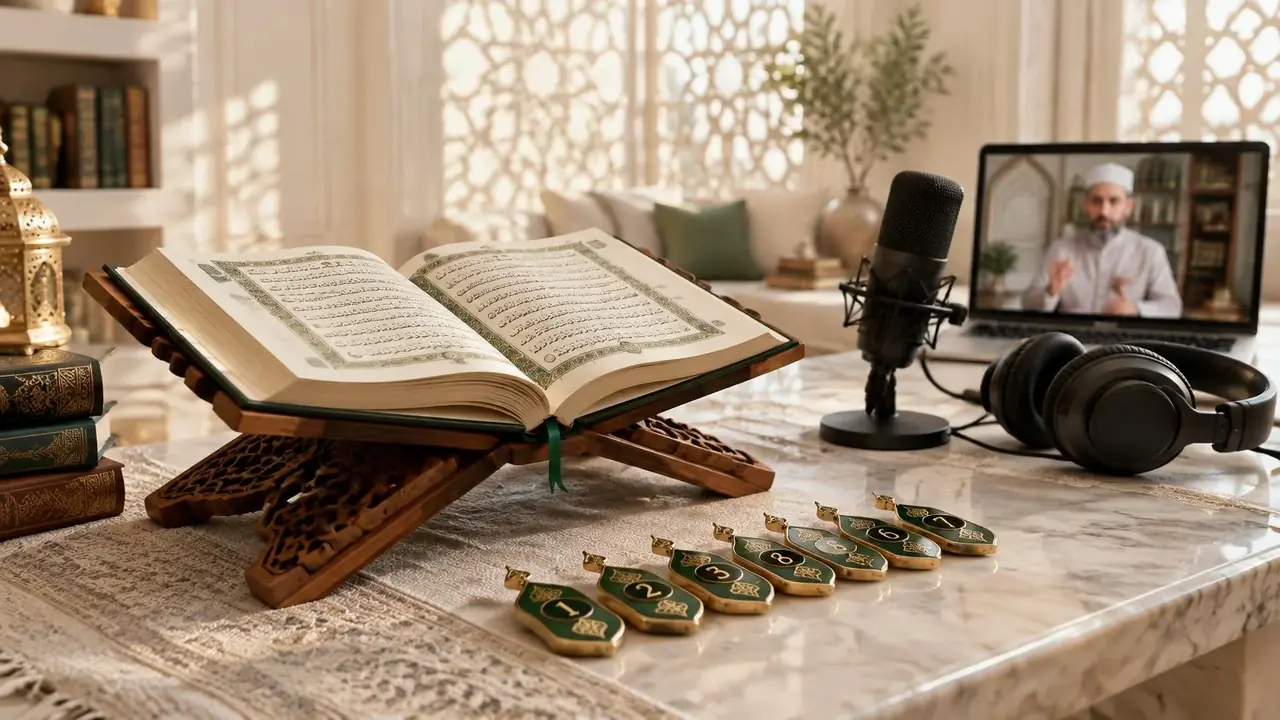
Recite aloud to a qualified teacher rather than silently to yourself. Tajweed is an oral tradition; correction has to be heard in real time.
Record one short passage each week and compare it with the previous week. Progress becomes obvious and motivating.
Common beginner mistakes
Over-lengthening madd, dropping qalqalah at the end of verses, and blending letters that should stay distinct are the three corrections our teachers make most often.
Keep learning with Alazhar School
Short Quran lessons, recitations and tips every week.
Knowledge check
One-question quick quiz
What is the best way to improve Tajweed accurately?
Frequently asked
Learning with Al-Azhar online
Can I study Tajweed online from the USA, UK or Europe?
Yes. Live one-to-one classes are scheduled around international time zones, with the same teacher each week.
Are male and female Al-Azhar teachers available?
Yes. Families may request a qualified male or female teacher, subject to schedule availability.
Can I try a class before choosing a plan?
Yes. Every learner can book a 100% free trial class to meet a teacher and receive a starting-level recommendation.